I built SimpleAnki to finally start an Anki habit. I consume a tremendous amount of information—books, papers, podcasts, conversations—and retain embarrassingly little of it. Dwarkesh's conversation with Andy Matuschak crystallized this for me: most of what we read evaporates within weeks unless we deliberately work to retain it.
Spaced repetition is one of the most well-documented techniques in cognitive science. The basic insight is simple: you remember things better when you review them at increasing intervals, right before you're about to forget. By moving knowledge into long-term memory, you effectively expand your working memory—freeing up cognitive resources for higher-order thinking. Anki has been the gold standard here for over a decade.
But there's a catch that most people miss: spaced repetition only works if you've actually learned the material first. Reviewing a flashcard you never understood is just rehearsing confusion. This is why so many people fail with Anki—they try to memorize before they comprehend.
LLMs have changed this equation. For the first time, we have a tool that can have a genuine back-and-forth with you about a concept, probe your understanding, and determine whether you've actually grasped something or are just pattern-matching. The conversation becomes a filter: only the things you've truly learned get promoted to your spaced repetition queue.
SimpleAnki is built around this insight. Learn something with Claude, and it can immediately queue it for long-term retention—no manual card creation, no context switching. More broadly, this is an exploration of how LLMs can become proactive assistants in our lives, anticipating needs rather than waiting to be asked.
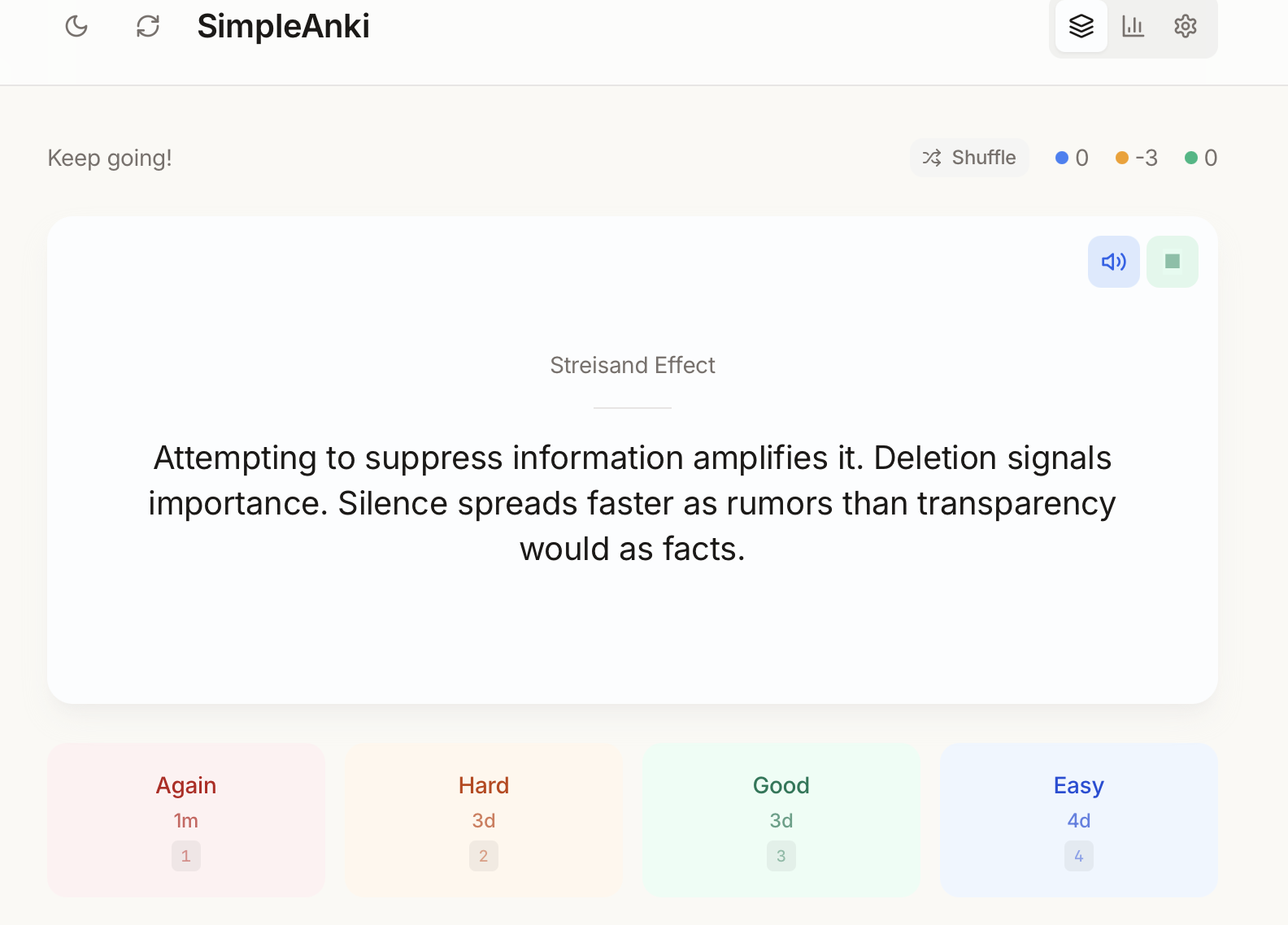
Review interface with SM-2/FSRS scheduling